SMSC Pod 5 Storage Bay
The Lost SymbolThe SMSC Pod 5 Storage Bay is a cavernous, unlit storage pod at the Smithsonian Museum Support Center whose emptiness allowed Peter Solomon to build Katherine Solomon a laboratory suited to experiments that ordinary research facilities could not support. Its sealed, isolated environment became both the material foundation of Katherine’s work and the setting for a private family gift: a lab concealed within a warehouse of museum artifacts, reached by a walk through darkness that Katherine initially could not navigate.
Setting and Design
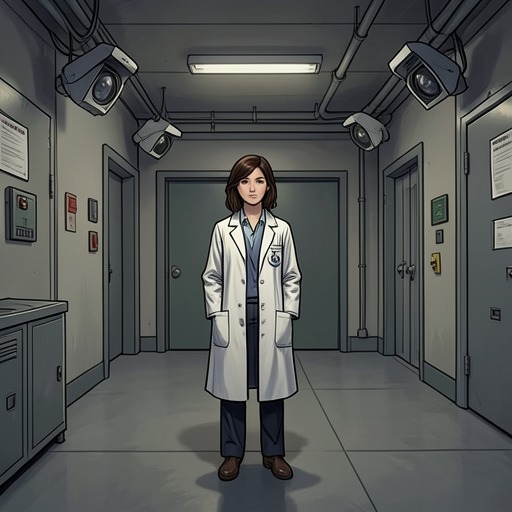
The bay is one of five massive storage pods connected by a long central corridor known as The Street. During Peter’s first tour of the Smithsonian Museum Support Center with Katherine, he showed her unusual holdings along the way, including the Mars meteorite ALH-84001, Sitting Bull’s handwritten pictographic diary, and original specimens collected by Charles Darwin and kept in wax-sealed Ball jars. The scale and strangeness of the collection made the building seem unlike an ordinary research facility; Pod 5, however, was striking for what it did not yet contain.
The pod had been built to house artifacts from the basement of the National Museum of Natural History, but their relocation was not expected for about five years. At the time Peter showed it to Katherine, the space was therefore sitting empty. He saw that temporary vacancy as an opportunity: instead of letting an unused storage bay remain merely a void, he could place Katherine’s research inside it. The future arrival of the collection also gave the arrangement a bounded character; the lab could use the space while it remained available, then move out when the pod was needed for its intended purpose.
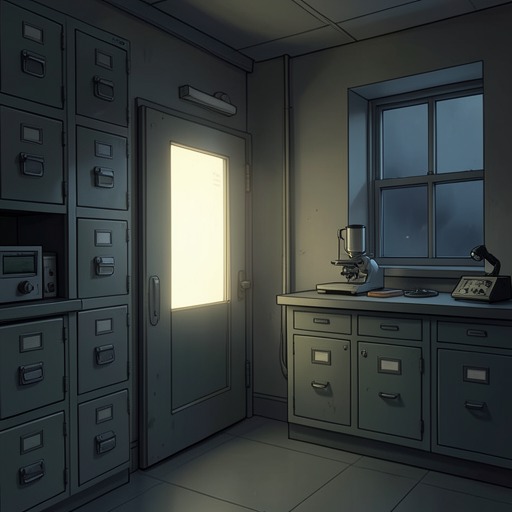
The bay was too voluminous to heat as a whole. Katherine’s lab occupied a roughly cube-shaped, thermally insulated cinder-block room in the pod’s farthest corner, creating a smaller workspace within the immense storage volume. Peter described the distance in practical but unsettling terms: a football field would fit easily inside the bay, and the journey to the lab was long enough to be unnerving. At their first entrance, the open steel door gave Katherine a view only of blackness; a hollow moan and a blast of cold air came from within. The pod’s scale was not abstract architecture but something she had to cross on foot.
A Laboratory Made Possible by Isolation
Peter’s gift was tailored to the requirements of Katherine’s research. Her experiments sought to quantify previously unknown energy fields, so she needed a setting free from extraneous radiation and what she called white noise. Even interference as subtle as brain radiation or thought emissions from nearby people could compromise the conditions she wanted to study. A university campus or hospital laboratory would not provide the necessary separation; an empty bay at the Smithsonian Museum Support Center could.
The pod itself was not wired for electricity, but Peter had already arranged another source of power: a hydrogen fuel cell capable of supplying enough clean energy to run a small town. The laboratory also had full radio-frequency separation from the rest of the building. Photo-resistant membranes sealed the exteriors of all the pods to protect the artifacts within from solar radiation, making Pod 5 a sealed, energy-neutral environment. These features joined the isolation required by Katherine’s work to the storage facility’s preservation function: the same design that protected collections from outside exposure helped give her experiments a controlled setting.
Peter presented the lab as more than a sibling’s favor. He told Katherine that he had used his own money, and argued that supporting her work served the Smithsonian’s purpose of advancing scientific knowledge. He believed her proposed experiments could push science into uncharted territory and said he would have felt obliged to support them even if she were not his sister. The lab’s location thus carried both a practical rationale and a personal one: it was an unusually well-matched research environment made available through Peter’s confidence in Katherine’s ideas.
Katherine’s First Crossing and the Lab’s Use
At the steel door marked POD 5, Peter warned Katherine that the pod was exceptionally dark and that there was no light switch. When she asked how a laboratory could function without electricity, he revealed the hydrogen fuel cell. He then led her into the darkness before she could fully take in the space. Peter had already disappeared from view when Katherine hesitated at the threshold; he urged her to follow and trust him. The door hissed shut behind her, leaving her unable to see even her hand directly in front of her face. She moved tentatively, but within seconds she was lost.
That first entrance became a memory against which the present journey is measured. Three years later, Katherine’s lab—nicknamed The Cube—had become her home and sanctuary in the depths of Pod 5. Peter had predicted that she would find her way through the darkness, and she did, using an ingeniously simple guidance system that he had allowed her to discover for herself. The contrast between the first crossing, when she was frightened and disoriented, and the repeated journeys that followed marks how thoroughly the unfamiliar bay became part of her daily life.
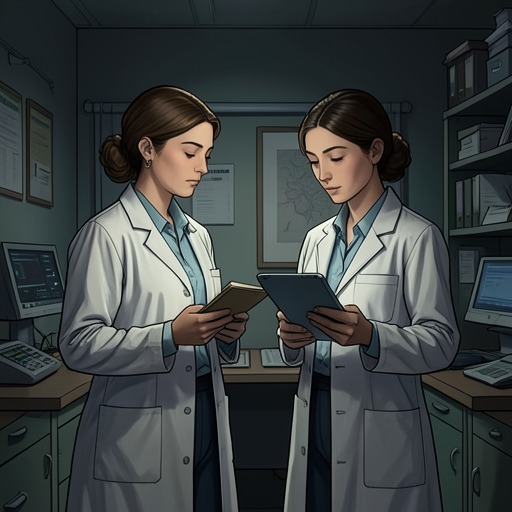
The laboratory also yielded the kind of results Peter had hoped to make possible. Katherine’s experiments produced astonishing findings, especially during the six months before the events of the present scene. She and Peter agreed to keep the results absolutely secret until their implications were better understood. Katherine believed that she would soon publish revelations capable of changing scientific paradigms. The bay therefore sheltered not just equipment and research but work whose potential significance Katherine and Peter considered too consequential to disclose prematurely.
Return to the Door
When Katherine arrives at Pod 5 three years after her first crossing, the physical entrance remains unchanged: she inserts her key card, enters her PIN on the illuminated keypad, and opens the steel door. The hollow moan and cold air recur, and her pulse begins to climb as she prepares for the journey through the void. What has changed is her experience of the place. The darkness that once made her entirely lost now leads to the lab she knows as home.
But this return is shadowed by Peter’s unexplained absence. Katherine has just learned something troubling about her brother, and he has failed to answer her phone. For three years, he had always arrived first at their weekly Sunday-night meetings at seven, a private family ritual that kept them connected and let him hear about her laboratory work. As she enters the pod, she is still trying to work out what to ask him and why he is not there. The storage bay’s familiar darkness therefore carries a new uncertainty: it remains the refuge Peter made possible, but the unanswered question of his whereabouts follows Katherine inside.